Balatro Joker Order Guide: 7 Rules to Maximize +Mult and XMult
A practical guide to left-to-right Joker placement, copy effects, Polychrome timing, and common ordering mistakes that quietly reduce your score.

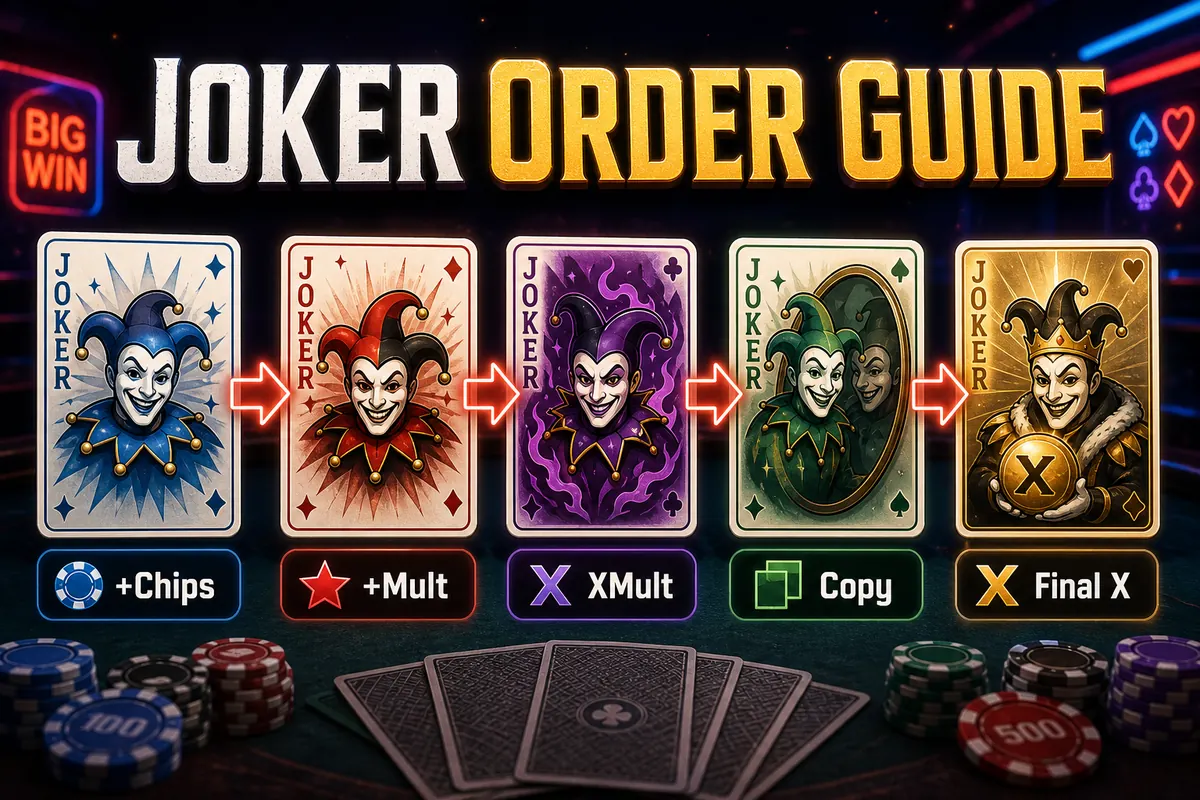
Balatro Joker order matters because many scoring effects resolve from left to right. A strong Joker can still underperform if it triggers before the Mult it should multiply, or if a copy Joker repeats the wrong target. This guide focuses on practical ordering decisions rather than memorizing every possible build.
Quick Answer: What Is the Best Joker Order in Balatro?
For most score-focused hands, the default Joker order is chip Jokers first, then +Mult Jokers, then XMult Jokers. Effects that multiply your Mult should usually be placed after the effects that add Mult, because multiplying a larger Mult value produces a larger final score.
That rule is a starting point, not a law. Some Jokers trigger when a card is scored, some trigger when the hand is evaluated, some copy another Joker, and some care about position. When a Joker has unusual timing, read its effect and test the exact build before assuming the standard order is correct.
Use this simple default
Left side: chips and +Mult. Middle: conditional setup effects. Right side: XMult, Polychrome, and final multipliers. Copy effects should sit where they repeat the strongest useful effect.
How Joker Trigger Order Works
In ordinary scoring, Balatro evaluates the played hand, scores eligible cards, then applies relevant Joker effects. Jokers in your Joker slots are generally checked from left to right, so the same five Jokers can produce different scores if their positions change.
The most important distinction is additive versus multiplicative scoring. +Mult adds to the current Mult total. XMult multiplies the current Mult total. If an XMult Joker triggers before a +Mult Joker, it multiplies a smaller number and leaves score on the table.
This is why a Balatro joker order calculator is useful for complicated builds, but you can solve many common hands by understanding the timing categories below.
7 Rules for Optimal Joker Order in Balatro
- Put +Chips early: Chip Jokers do not usually care about Mult timing, but placing them early keeps your layout easy to read. They increase the chip side of the score formula rather than multiplying Mult.
- Put +Mult before XMult: This is the most common ordering rule. Add Mult first so that later XMult effects multiply a bigger base.
- Place XMult late: Jokers such as strong conditional multipliers usually belong toward the right side unless another effect specifically needs to copy them from a different position.
- Treat Polychrome like a multiplier: Polychrome adds an extra XMult-style effect, so a Polychrome Joker is often stronger when it sits after your additive Mult sources.
- Aim Blueprint at the best repeatable effect: Blueprint copies the compatible Joker to its right. Place it immediately left of the effect you actually want to repeat, not simply next to the highest-rarity Joker.
- Aim Brainstorm at your leftmost Joker: Brainstorm copies the leftmost Joker, so your leftmost slot becomes a strategic target. If the leftmost Joker is weak or non-compatible, Brainstorm may waste value.
- Test edge cases before boss blinds: Face-card builds, retrigger builds, copied effects, editions, and conditional Jokers can break the simple pattern. Verify high-stakes layouts with a calculator before locking in a risky line.
Joker Type and Recommended Position
| Joker type | Typical position | Reason | Example decision |
|---|---|---|---|
| +Chips | Left | Adds chip value and keeps the layout readable. | Move chip-only effects before Mult decisions. |
| +Mult | Left to middle | Creates the Mult base that later effects multiply. | Put a flat +Mult Joker before XMult. |
| XMult | Middle to right | Multiplies the current Mult total. | Move strong XMult effects after additive Mult. |
| Polychrome | Usually right | Acts like an additional multiplier. | Do not waste it before your Mult is built up. |
| Blueprint | Left of target | Copies the compatible Joker to its right. | Place it directly before the Joker you want repeated. |
| Brainstorm | Depends on leftmost target | Copies the leftmost Joker. | Make the leftmost Joker the effect worth copying. |
| Retrigger support | Build-specific | May depend on scored cards rather than only Joker slots. | Check whether the trigger happens during card scoring or final Joker scoring. |
Worked Examples: Same Jokers, Different Score
The easiest way to understand optimal Joker order is to compare the same effects in different positions. These examples use simplified numbers so the timing is clear.
Example 1: +Mult before XMult
Weak order: Base Mult 10, X2 triggers first, then +20 Mult: 10 x 2 + 20 = 40 Mult.
Better order: Base Mult 10, +20 triggers first, then X2: (10 + 20) x 2 = 60 Mult.
Lesson: The Jokers are identical, but the second order gets 50% more Mult because the multiplier happens later.
Example 2: Polychrome timing
Weak order: A Polychrome Joker applies before your main +Mult source, multiplying a smaller Mult total.
Better order: Place the Polychrome effect after your +Mult sources when the Joker effect allows it.
Lesson: Polychrome often behaves like a final multiplier, so late placement is usually safer.
Example 3: Blueprint target choice
Weak target: Blueprint copies a small +Chips effect because it is placed before the wrong Joker.
Better target: Blueprint sits immediately left of a compatible high-value XMult or scaling +Mult effect.
Lesson: Blueprint is only as useful as the effect it repeats. Position matters more than card rarity.
Blueprint, Brainstorm, Baron and Mime: When the Simple Rule Is Not Enough
Copy Jokers are the main reason Balatro joker order can become unintuitive. Blueprint cares about the Joker on its right, while Brainstorm cares about the leftmost Joker. That means you sometimes move a strong Joker away from the far-right slot so a copy effect can reach it.
Baron and Mime style builds also require extra care because retriggers and held-card effects can change where your value is created. In those builds, the question is not only whether +Mult comes before XMult. The better question is: which effect is being repeated, and how many times does it resolve?
When a run has several copy or retrigger effects, use the article rules as a checklist, then verify the final result with the main Balatro Calculator. Manual intuition is useful, but complex copy chains are easy to misread.
Common Joker Order Mistakes
- Putting XMult too far left: This is the classic mistake. The multiplier fires before your Mult has been built, so the final score is lower than it should be.
- Copying the rarest Joker instead of the best effect: Blueprint and Brainstorm should copy the effect with the best scoring impact in the current hand, not automatically the flashiest Joker.
- Ignoring conditional timing: Some Jokers only matter for specific hands, suits, ranks, editions, or scoring cards. If the condition is not active, perfect position cannot save the build.
- Optimizing one hand while losing the run plan: The best order for a single hand may not be the best plan if it makes your next blind, economy, or scaling path worse.
A Practical Ordering Workflow Before You Play
- Identify which Jokers add chips, which add Mult, and which multiply Mult.
- Move chip and +Mult effects to the left side unless a copy effect needs a different target.
- Move XMult and Polychrome effects toward the right side.
- Set Blueprint directly left of the effect it should copy.
- Make sure Brainstorm's leftmost target is worth copying.
- Check whether any Joker triggers during card scoring instead of final Joker scoring.
- Run the exact build through the calculator when the blind requirement is close.
Conclusion: Use Rules First, Then Verify Close Calls
The best Balatro Joker order is usually not complicated: build chips and +Mult first, then apply XMult and Polychrome effects later. This one habit fixes many low-score layouts immediately.
The hard cases are copy effects, retriggers, and condition-heavy builds. For those, think in terms of what each Joker repeats and when the value is created. If the run depends on a narrow score threshold, verify the exact order before playing the hand.
Balatro Joker Order FAQ
References and useful resources
About the Author
Balatro Calculator Team
The Balatro Calculator Team builds fan-made score and probability tools for players who want to understand scoring interactions before committing to a hand or shop purchase.
Last updated: July 10, 2026