Balatro Boss Blinds Guide: List, Effects and Counter-Strategies
A practical reference for every Boss Blind, the build dependency it attacks, and the small preparation that keeps a good run from losing to one modifier.

The best way to read a Balatro Boss Blind is to ask what it removes from your build before asking whether your current score is high enough. A score calculator can tell you if a hand clears the target, but the Boss Blind decides whether that hand can still be played, whether its cards remain active, and whether your next draw is reliable. This guide gives you the full Boss Blind list, the first adjustment to make for each modifier, and a simple reroll test for tight runs.
How Boss Blinds change an Ante
Each Ante normally asks you to pass a Small Blind, a Big Blind and then a Boss Blind. The score target rises with the Ante, but the Boss is dangerous because it changes the rules around your score. A normal hand that wins the Big Blind can fail immediately when a suit is debuffed, a hand type is locked, or your cards are hidden before you choose what to play.
Read the warning panel before entering the round. Check the blind name, the target, the number of hands and discards, and the current state of your Jokers. If the modifier attacks your main plan, spend the shop before the Boss on flexibility rather than another narrow upgrade. A spare suit, an off-plan hand level or one Joker that still works under a debuff is often worth more than a slightly larger theoretical multiplier.
The table below uses the Boss Blind name as the search key, then translates the effect into a player decision. It is not a tier list: a weak-looking Boss can be fatal for the wrong build, while a scary Boss becomes routine when you have preserved the right fallback.
Read the modifier before the number
A high score does not help if the Boss Blind removes the hand, suit, rank or Joker effect that creates that score.
Full Balatro Boss Blind list
Use this as a quick reference rather than memorizing every line. The most useful column is the first response: it tells you what to check before spending money, playing a hand or using a discard. Boss names and effects can interact with deck type, Stake rules, Jokers, Enhancements and seals, so treat the response as a starting point rather than a guaranteed solution.
| Boss Blind | Appears from | What changes | First response |
|---|---|---|---|
| The Hook | Any Ante | Discards two random held cards after each played hand. | Keep redundant cards and avoid relying on one exact held card. |
| The Ox | Ante 6 | Playing your most-played hand sets your money to zero. | Check your shop budget and use a different hand if the score allows. |
| The House | Ante 2 | The first hand is drawn face down. | Plan a safe opener that does not require perfect information. |
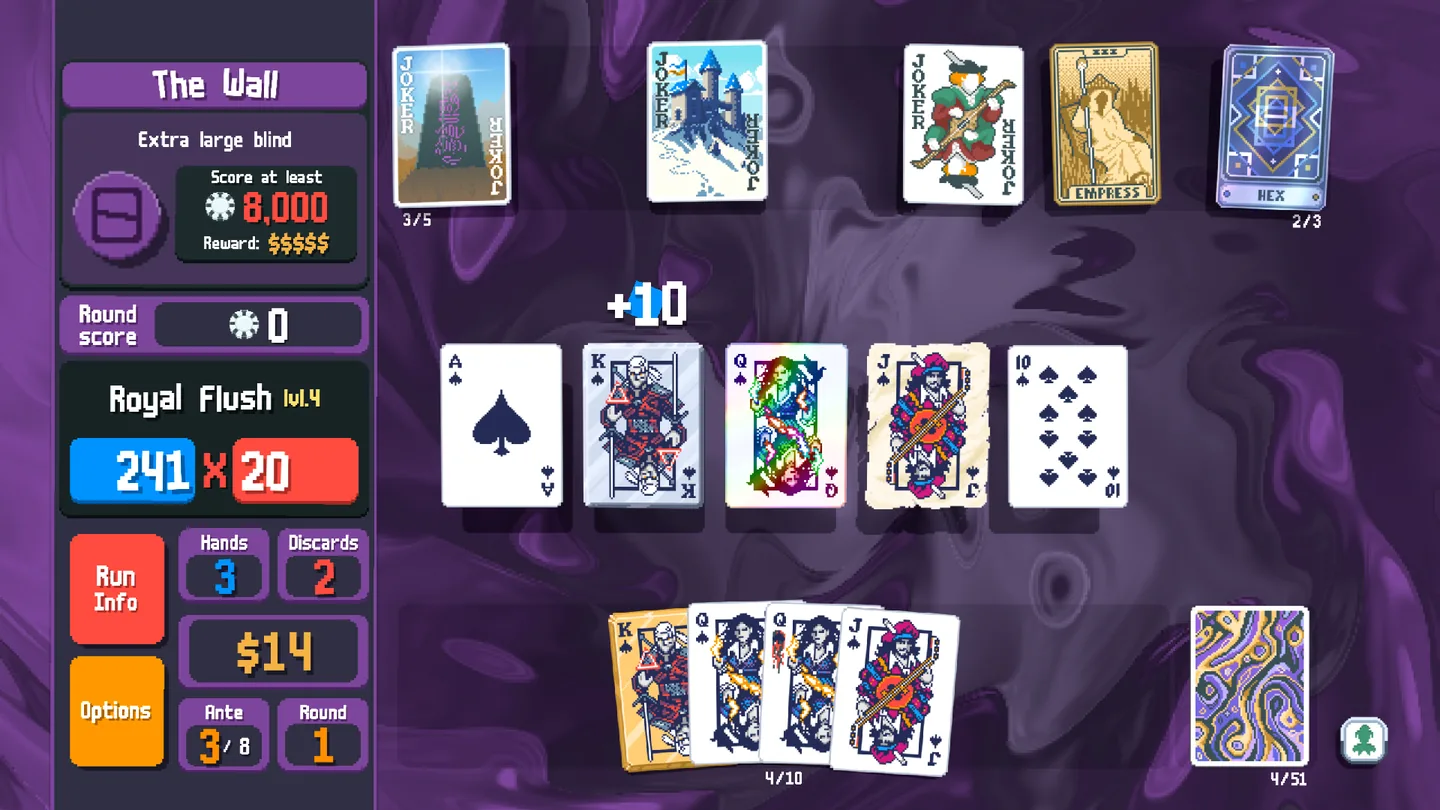
| The Wall | Ante 2 | The blind is extra large. | Enter with a score buffer instead of a barely passing hand. |
| The Wheel | Ante 2 | Some cards can be drawn face down during the round. | Favor flexible hands and do not assume every draw is readable. |
| The Arm | Ante 2 | The played poker hand loses a level, down to Level 1. | Preserve a second scoring hand and value raw Joker power. |
| The Club | Any Ante | Club cards are debuffed. | Check your best suit mix and keep a non-Club route. |
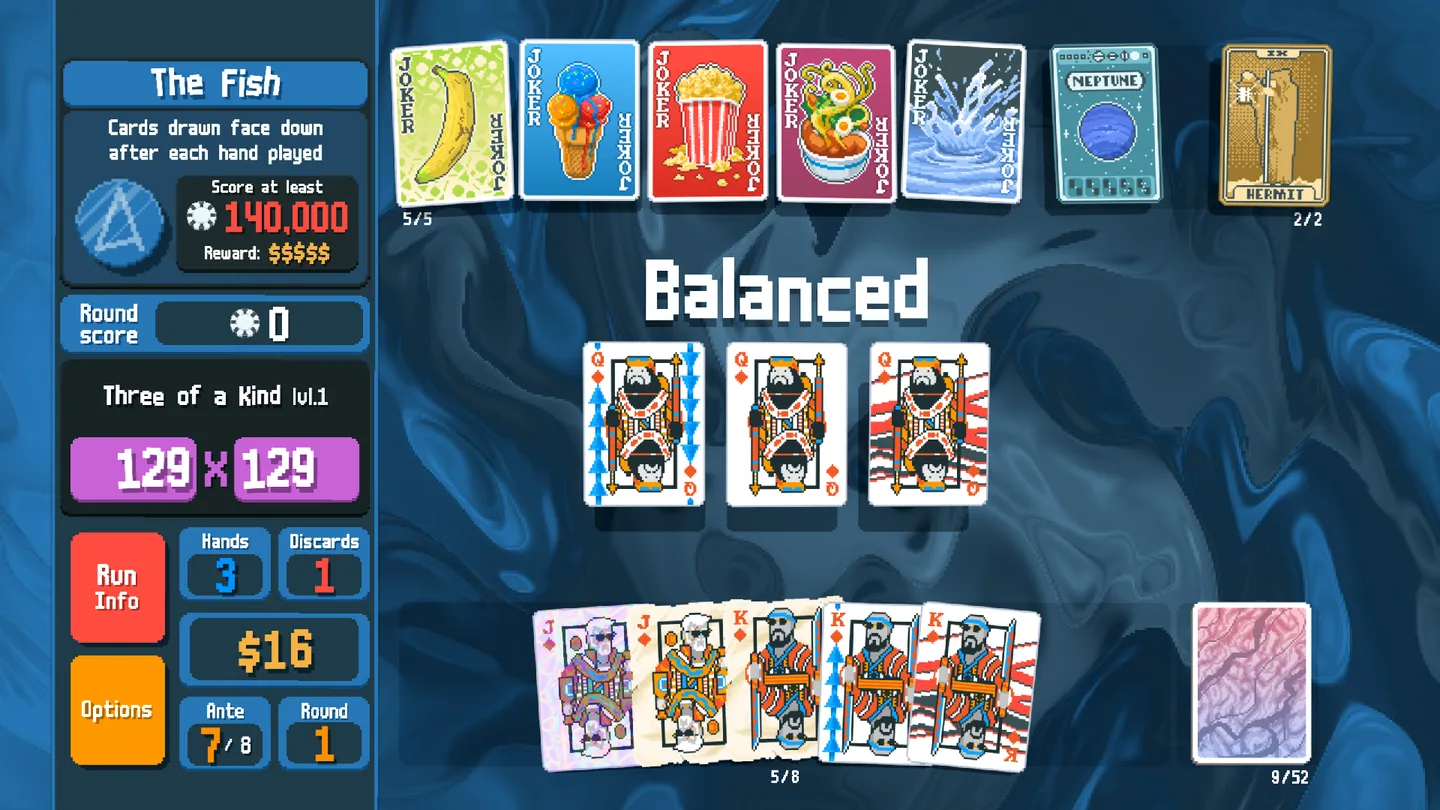
| The Fish | Ante 2 | Cards are drawn face down after each played hand. | Choose a hand before the next draw whenever possible. |
| The Psychic | Any Ante | You must play five cards, although not all need to score. | Keep enough cards and avoid a build that only works with a short hand. |
| The Goad | Any Ante | Spade cards are debuffed. | Do not enter with a Spade-dependent scoring line. |
| The Water | Ante 2 | You start the round with zero discards. | Treat the opening draw as the real test and keep hand quality high. |
| The Window | Any Ante | Diamond cards are debuffed. | Keep a suit-independent fallback before the Boss. |
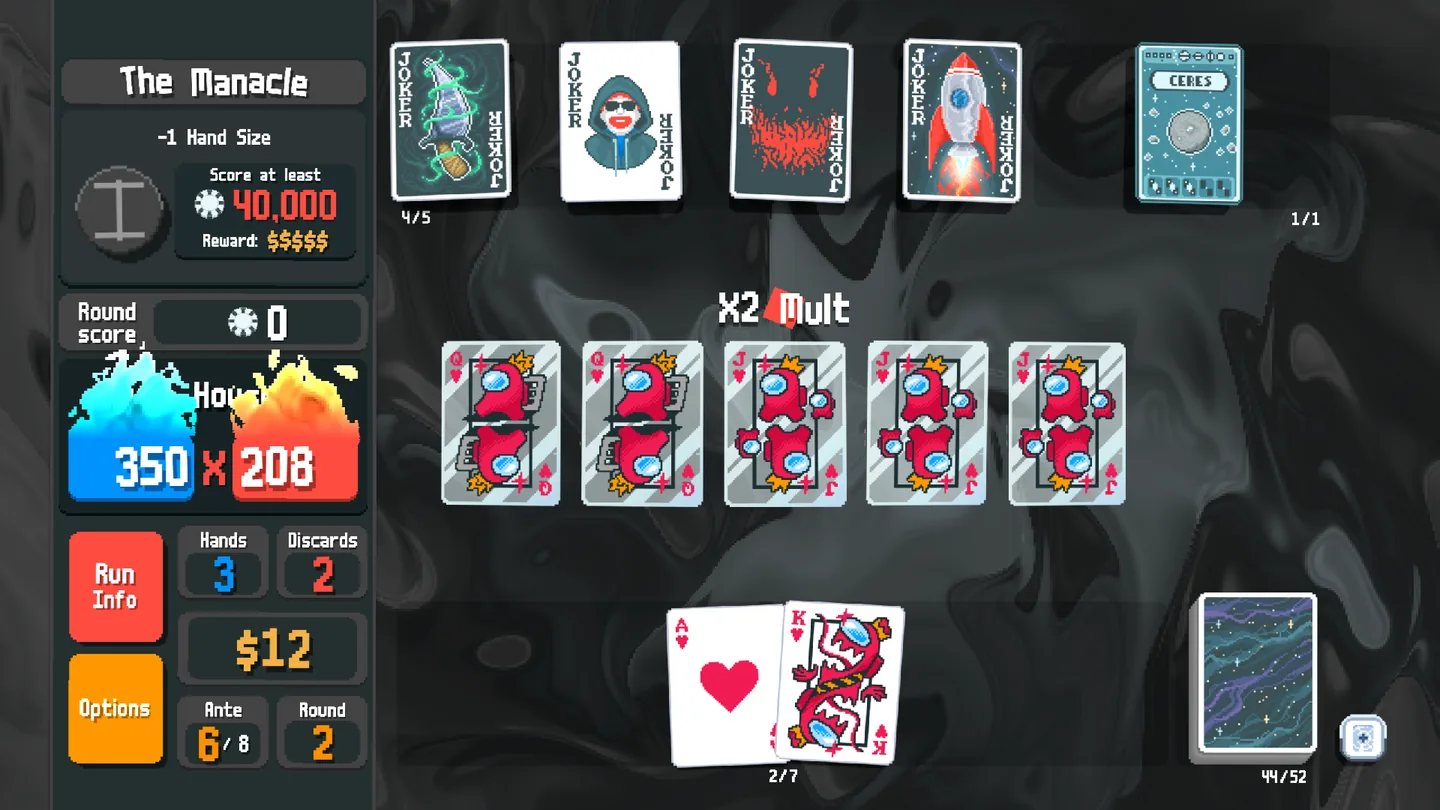
| The Manacle | Any Ante | Hand size is reduced by one. | Remove weak cards and protect the hand that carries your engine. |
| The Eye | Ante 3 | You cannot repeat a hand type during the round. | Prepare at least two or three scoring hand types. |
| The Mouth | Ante 2 | Only one hand type can be played during the round. | Decide the hand before entering and do not waste levels elsewhere. |
| The Plant | Ante 4 | Face cards are debuffed. | Check whether your core Jokers or scoring cards depend on faces. |
| The Serpent | Ante 5 | After each play or discard, three cards are drawn. | Expect a changing hand and avoid plans that need a held card to stay put. |
| The Pillar | Any Ante | Cards already played earlier in the Ante are debuffed. | Do not assume a card that scored in Small Blind will score again. |
| The Needle | Ante 2 | You may play only one hand. | Enter with a single reliable line and a large score buffer. |
| The Head | Any Ante | Heart cards are debuffed. | Check suit coverage before relying on a Heart hand. |
| The Tooth | Ante 3 | You lose money for each card played. | Set a cash floor and avoid expensive, low-value chip-filling hands. |
| The Flint | Ante 2 | Base Chips and Mult for played hands are halved. | Rely on scaling Jokers and calculate the actual score instead of guessing. |
| The Mark | Ante 2 | Face cards are drawn face down. | Use non-face anchors and do not force a face-card opener. |
| Amber Acorn | Ante 8 | Your Jokers are flipped and shuffled. | Record the important order and keep the run playable without one exact position. |
| Verdant Leaf | Ante 8 | All cards are debuffed until you sell one Joker. | Reserve a sellable Joker and check the cost before committing to the round. |
| Violet Vessel | Ante 8 | The final blind has a very large target. | Bring a deep score buffer and avoid a build that only survives on luck. |
| Crimson Heart | Ante 8 | One random Joker is disabled on each hand. | Spread value across several Jokers and verify the active effect each hand. |
| Cerulean Bell | Ante 8 | One card is forced to be selected. | Build around the forced card when useful and keep your hand plan flexible. |
Ante 8 and finisher Boss Blinds
Ante 8 is not one fixed final test. The finisher Boss Blind can ask for a much larger target, disable part of your Joker engine, shuffle the order you planned, debuff every card until you sell something, or force a card into your hand. That is why a build that is excellent in Ante 7 can still be fragile: it may have enough output but no way to preserve its output under a changed rule.
The safest preparation is a buffer of options. Keep one scoring line that does not depend on a single suit or face-card rank, keep enough money to respond to a forced sale when possible, and do not spend every consumable before the final shop. If the finisher attacks Joker order, remember that the first evaluation after the Boss can be different from the order you used in the previous blind.
You do not need to predict every possible finisher. You need to stop your run from having only one way to score. That is the same reason a flexible deck can outperform a higher theoretical score on a long route.
- Amber Acorn: Treat Joker order as temporary. Recheck copies, retriggers and left-to-right effects after the shuffle.
- Verdant Leaf: Decide in advance which Joker can be sold without destroying your score or economy.
- Crimson Heart: Use distributed power. A single all-important Joker is a liability when the disabled slot changes every hand.
- Cerulean Bell: The forced card can be a benefit if your deck has good rank, suit and Enhancement coverage.
How to prepare your deck and Jokers
Preparation starts one shop earlier than most players expect. Before the Boss Blind, inspect the next target and ask which part of your build is least replaceable. If your score comes from one suit, one face-card trigger or one repeated hand type, the next purchase should buy an escape route when the shop offers one.
Joker order also matters. A Boss Blind can change whether a copy target is active, whether a retrigger still sees the card you expected, or whether a debuffed Joker provides any useful effect. Move from broad checks to exact scoring: first confirm the hand is legal, then confirm the cards are active, then check the order and final score.
A strong Boss Blind plan is usually less glamorous than a new multiplier. It can be a spare discard, a second hand type, a suit conversion, a card held for a debuff, or enough money to buy one stabilizing piece. These options are what keep a small modifier from becoming a forced restart.
- Suit coverage: Do not let one suit carry every scoring hand when Club, Spade, Diamond or Heart debuffs are possible.
- Hand coverage: Keep a primary hand and at least one fallback for The Eye, The Mouth and The Needle.
- Rank coverage: Face-card engines need a plan for The Plant and The Mark.
- Hand-size buffer: The Manacle, Psychic and forced-selection effects punish a deck that barely has enough cards.
- Joker redundancy: Spread the run across roles so one debuff, shuffle or random disable does not remove all output.
When to reroll a Boss Blind
Director's Cut and Retcon make a Boss Blind reroll possible, but a reroll is not automatically correct. Treat it as a purchase with an opportunity cost: the money could buy a Joker, a Planet, a card removal or a future interest threshold. Reroll when the modifier attacks the only scoring line you can realistically play and the reroll still leaves enough money to stabilize.
Do not reroll simply because the Boss name looks annoying. If the modifier is survivable with a different hand, a held card, a small Joker reposition or a calculated one-hand line, the money is often better kept. Rerolling a manageable Boss can leave you weaker for the next shop and the next Ante.
A useful threshold is confidence, not a universal dollar amount. If the current Boss gives you one reliable line with a healthy score buffer, keep it. If it gives you no legal line, no fallback and no affordable preparation, reroll before spending the last of your resources.
Reroll the dependency, not the name
Spend for a reroll when the modifier removes your only practical line and the new blind can still be supported by the remaining economy.
A calculator-backed decision workflow
Use the tools in the right order. Start with the Boss Blind rule, then check whether your intended hand is legal and drawable. Next use the build or score calculator with the actual Chips, Mult, hand level, Enhancements, seals and Joker order that will exist in the round. A generic score estimate is not enough when The Flint halves base values or The Arm lowers the hand level.
For uncertain draws, compare score and probability instead of chasing the biggest number. A hand with a slightly lower ceiling but a reliable draw can be the correct answer against The Water, The Needle or The Psychic. If the score clears the target by only a few points, treat it as fragile and preserve a discard, an alternate hand or a reroll option.
The calculator does not know every hidden state of your live run. It is a transparent check for the math you enter. Re-read the Boss Blind after every shop action, because a new Joker, a suit conversion or a hand-level change can alter the best line.
- Legality first: Confirm the Boss allows the hand, cards and number of plays you plan to use.
- Enter final values: Use the post-Joker, post-Enhancement Chips and Mult rather than an early estimate.
- Check a fallback: Run one practical backup hand when the Boss changes draws, suits, face cards or hand size.
- Keep a buffer: A barely passing result is not safe when one card can be debuffed or drawn face down.
Common mistakes and a 30-second checklist
Most Boss Blind losses are preparation errors rather than bad luck. Players enter with a high theoretical score, forget that the first hand is hidden, spend every discard before The Water, or assume the Joker order from the previous Blind still applies. Slow down for one short check before you click Start.
When the run is close, write down the exact hand you want, the cards that must remain active, the Joker that must trigger first and the minimum score you need. If any answer depends on a single random draw, the run is not safe yet. Buy flexibility, calculate the fallback and only then commit the hand.
- Name the threat: Say out loud what the Boss disables: suit, rank, hand, discard, hand size, cards, Joker or score.
- Check the first hand: The House, Fish, Mark and Wheel can make the opening information worse than expected.
- Protect the economy: The Ox and Tooth can make a successful round still damage the next shop.
- Recheck order: Debuffs, shuffles and random disables can make yesterday's winning sequence wrong today.
- Choose the safest line: The best Boss Blind play is the line that clears the target and leaves a future run, not the highest screenshot number.
Balatro Boss Blinds FAQ
References and media sources
About this guide
Balatro Calculator Team
The Balatro Calculator Team builds fan-made score, odds and Joker-order tools for players who want to understand a run before committing a hand, a discard, a shop purchase or a reroll.
Last updated: August 10, 2026