Balatro Shop Strategy: When to Buy, Reroll, or Save
A run-first method for choosing between a visible card, a pack, a reroll, a sale, and the cash you carry into the next blind.


A useful Balatro shop strategy weighs the next blind against each offer and the cash left afterward. Buy for a real scoring, consistency, economy or blind-specific need; save when the build is safe and future options matter more. This guide compares cards, packs, rerolls, sales and reserves without assuming every run has the same budget.
Balatro Shop Strategy: The Quick Check
Check the next blind, name one weakness, compare the offers with it, then count your remaining cash. This shop strategy keeps a rare Joker or tempting pack from distracting you from the round you must survive.
Buy for a real need: score, hand consistency, economy or a specific blind answer. Rarity alone is not a reason to spend. A short checklist is more useful than a fixed budget:
Shop strategy check
Secure the next blind; spend for a named need.
- Survival: Can the build beat the next blind and its Boss effect?
- Bottleneck: Do you need score, consistency, cash or a counter?
- Offer: Does it solve that need now?
- Price: What cash and interest remain after spending?
- Fallback: Can you still handle a weak result?
Start With the Next Blind
Read the target and restriction before shopping. A Boss Blind may disable a suit, change a hand rule or disrupt a key Joker. If that makes the next round dangerous, favor immediate score, consistency or a relevant counter over a payoff several shops away. This blind-first strategy protects the run before it invests in later value.
When the build is safe, compare long-term value. Money effects, shop upgrades and packs may repay over several rounds, but a slow payoff is weaker when the run's main test is close.
Match the purchase to the gap: improve consistency when draws fail, add score when hands fall short, or choose economy when both are stable. Do not pay to fix a weakness the next blind will not test.
Strategy before spending
Name the need: score, consistency, protection or time to scale.
When to Buy a Visible Card
A visible card is a known result. A buying strategy should favor it when it fits your current route; a Joker that fixes an immediate score gap can be safer than paying to see unknown cards.
If Joker slots are full, compare the new card with your weakest one. Include lost economy, support effects and trigger chains, not just the new card's score.
Pass when it duplicates a job, needs missing pieces or relies on an unclear future combo. Keep the cash for a better fit.
Buy with a reason
Name the gap it fills and the cash or slot it costs.
Choose a Pack or a Single Card
A single card is known; a pack offers uncertain choices. A pack strategy makes sense when several outcomes support your hand or deck plan and the cost leaves room for the next blind. Prefer the visible card when it solves an urgent problem.
Before opening, name the results you would take. If only one rare outcome helps, you are gambling on it; if several improve score, consistency or deck control, the selection may be worth paying for.
Compare the pack with the visible card and the cash you would keep. Do not value every possible pack outcome as though it were guaranteed.
| Shop option | Best fit | Main risk |
|---|---|---|
| Visible card | A known effect fills a current gap | May be redundant or displace a useful Joker |
| Booster pack | Several outcomes support the route | The useful result may not appear |
| Save the cash | The blind is safe and later shops matter | May leave an urgent score gap unresolved |
When to Reroll the Shop
A reroll replaces the shop's card slots, not its packs or voucher. This reroll strategy pays only when those slots miss a specific need.
Under base rules, the first reroll costs $5 and each later reroll in that shop costs $1 more; the price resets next shop. Set a ceiling before clicking, accounting for cash needed afterward.
Reroll when the next blind is risky, current offers do not help and you can afford another attempt. It is weaker when the build is safe or spending would cross a useful cash threshold.
After each result, compare it with the best offer you passed. Take an adequate fit, or stop at your budget instead of chasing sunk cost.
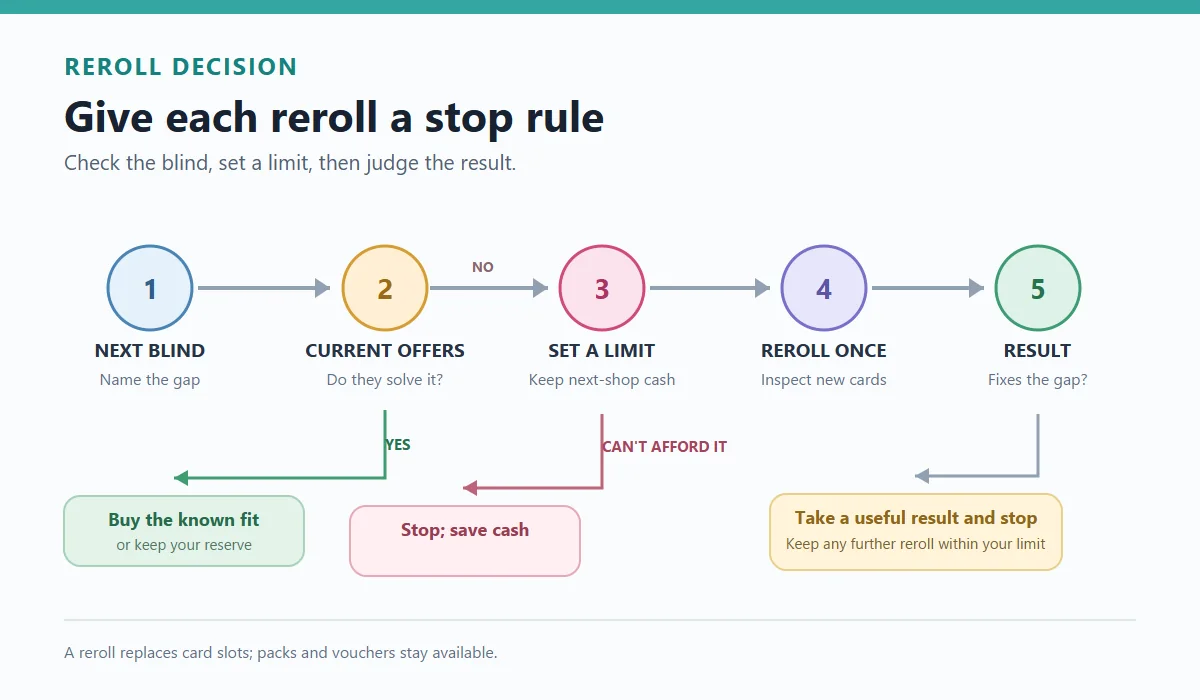
- Set a target: Choose a role, not one exact rare Joker.
- Set a ceiling: Include the rising price of later attempts.
- Stop when it works: A useful card beats an unaffordable perfect one.
When to Sell or Save Cash
A sale strategy works when a card no longer supports the route, its slot can hold a stronger answer or the proceeds unlock a needed purchase. Check whether it still earns money, enables a scoring chain or covers a blind risk. In the base game, many cards sell for about half their cost, rounded down, with a $1 minimum; effects can change the displayed price.
Saving preserves options and can earn interest. Base interest pays $1 per $5 held, up to $5 per round, so $25 reaches the usual cap. Extra cash above that does not raise base interest; below it, spending may reduce the next payment.
Judge the cash after spending. At $27, a $6 card leaves $21 and reduces next base interest from $5 to $4. That dollar may still be worthwhile if the card prevents a loss.
Cash is optionality
Keep useful choices; spend when an offer protects the run.
Cash and Interest Examples
These examples show a cash strategy under base interest and ignore discounts or bonuses. Check live prices and effects in your run.
At $27, buying a $6 card leaves $21 and lowers next interest from $5 to $4. At $35, a $5 first reroll leaves $30, still above the $25 cap; the cash is not free because later rerolls cost more and the next shop has less budget.
Treat the figures as comparisons, not fixed thresholds. A card that saves a dangerous run can justify the lost dollar; a speculative offer may not.
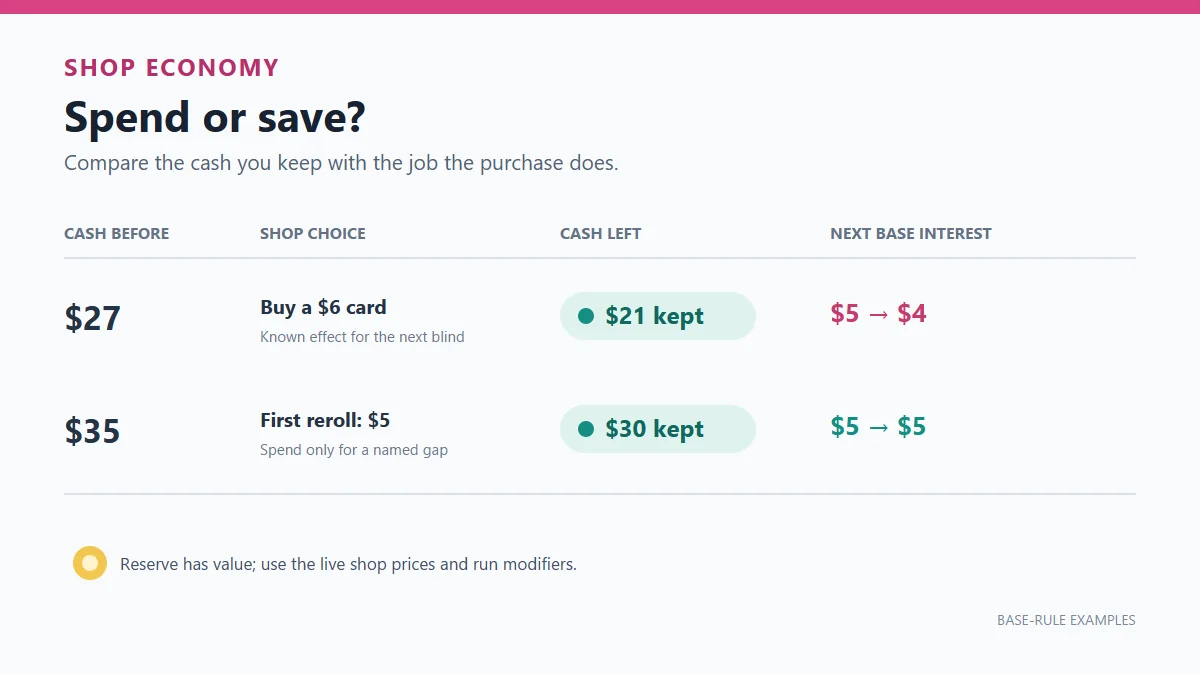
| Cash before | Choice | Cash after | Base interest change next round |
|---|---|---|---|
| $27 | Buy $6 | $21 | $5 to $4 |
| $35 | Reroll $5 | $30 | $5 stays capped |
| $23 | Buy $5 | $18 | $4 to $3 |
Shop Strategy Mistakes to Avoid
Do not hoard $25 when the next blind threatens the run; survival can be worth more than future interest. Also avoid buying every interesting item: choose the offer that fixes the biggest gap and preserve a workable reserve.
Do not reroll without a target or keep a weak Joker only because you paid for it. Set a ceiling, reassess each result and judge cards by their current role.
Prices and interest can change with your run. Check the shop display. Use the Balatro Build Calculator to check a scoring gap and the Voucher Guide for a specific voucher effect.
Flexible strategy
Spend for a need, cap rerolls and protect a useful reserve.
- Do not chase perfection: Take a useful fit and keep the run alive.
- Ignore sunk cost: Judge the Joker by its current role.
- Read the next blind: Future income matters only if you survive.
- Check live prices: Modifiers can change the base rule.
Balatro Shop Strategy FAQ
References and useful resources
About the Author
Balatro Calculator Team
The Balatro Calculator Team builds fan-made score, odds and Joker-order tools for players who want to understand a run before committing a hand, buying a shop card, spending a reroll or changing a build.
Last updated: November 4, 2026